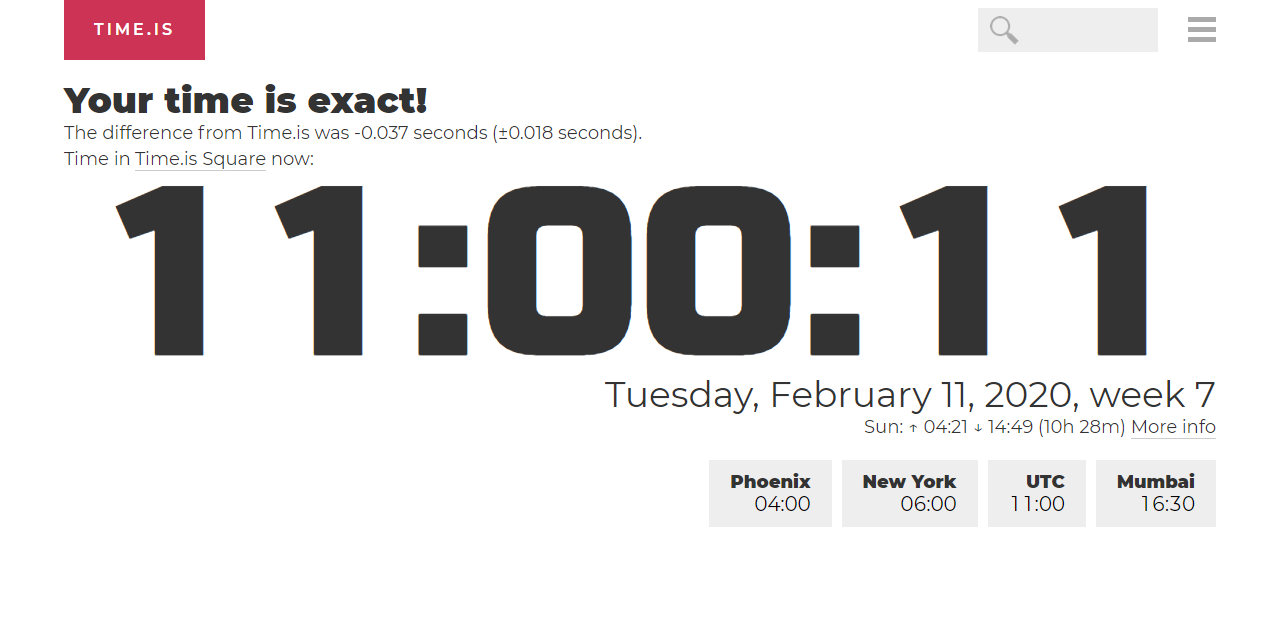
The Precision Backbone: How Official US Time Is Synchronized by NIST Atomic Clocks
In our fast-paced world, precise time isn't just a convenience; it's a fundamental requirement for everything from global communication and financial transactions to satellite navigation and scientific research. When we talk about Official US Time, we're referring to a highly accurate and synchronized system, meticulously maintained by the National Institute of Standards and Technology (NIST). But how exactly does this incredible precision, derived from the quantum realm of atomic clocks, translate into the seconds ticking on your wall clock or smartphone?
The journey of Official US Time begins in a highly secure facility in Fort Collins, Colorado, where NIST operates a network of atomic clocks that define the nation's authoritative time. These aren't just ordinary timepieces; they are scientific marvels that harness the consistent oscillations of atoms to achieve unparalleled accuracy, ensuring that every second across the United States is unified and unwavering.
The Heartbeat of Time: NIST's Atomic Clocks
At the core of Official US Time synchronization lies NIST's suite of atomic clocks, particularly those based on cesium atoms. The very definition of a second, according to the International System of Units (SI), is derived from the hyper-fine transition frequency of the cesium-133 atom. Specifically, one second is defined as 9,192,631,770 cycles of the radiation corresponding to the transition between two energy levels of the cesium-133 atom.
NIST doesn't rely on just one clock. Instead, it maintains a ensemble of highly accurate atomic clocks, including cesium fountain clocks and hydrogen masers, which are continuously monitored and averaged to create an even more stable and precise time scale. This ensemble ensures redundancy and significantly reduces the risk of error, making NIST's time scale among the most accurate in the world. These clocks are so precise that they would not gain or lose even one second in millions of years.
NIST's role extends beyond simply owning these clocks. As the National Institute of Standards and Technology, it is charged with maintaining physical measurement standards for the United States, which naturally includes time and frequency. This responsibility is crucial not only for scientific research but also for establishing information technology standards for the security of systems used by U.S. federal agencies, where synchronized and verifiable timestamps are paramount.
The commitment to such extreme accuracy stems from the critical need for a common, undeniable time reference. Consider the impact of even tiny discrepancies: in GPS systems, an error of a mere nanosecond (one billionth of a second) can translate to a positioning error of about a foot. In high-frequency trading, microsecond differences can cost millions. For robust cybersecurity, time stamps are vital for logging events, detecting intrusions, and ensuring the integrity of data.
How the Official US Time Signal Reaches You: WWV and WWVH
Having ultra-precise atomic clocks is one thing; distributing that precise time across a vast continent is another. NIST addresses this through a long-standing and highly effective method: radio broadcasts. From its facility in Fort Collins, Colorado, NIST operates radio station WWV, which continuously broadcasts a time signal on several AM radio frequencies. These include 2.5, 5, 10, 15, and 20 MHz.
Simultaneously, a complementary station, WWVH, broadcasts from Kekaha, Kauai, Hawaii, on frequencies of 2.5, 5, 10, and 15 MHz. While WWV uses a male voice for its announcements, WWVH uses a female voice, allowing listeners to differentiate between the two stations, especially in areas where signals from both might be received.
These AM band signals reach across most areas of the United States, as well as parts of Canada, Mexico, and beyond, depending on propagation conditions. Many specialized "atomic clocks" designed for home or office use contain a small AM radio receiver. This receiver is specifically tuned to one of the WWV/WWVH frequencies. Upon initial setup, or when activated, the clock listens for the broadcast signal. Once received, it sets its hands (or digital display) to the correct time and continues to make subtle adjustments as long as it receives the signal, ensuring continuous, highly accurate synchronization.
The broadcast doesn't just transmit the time of day. It also includes other valuable information encoded into the signal, such as UTC (Coordinated Universal Time) information, standard time zone markers, and even data about solar activity warnings that can affect radio propagation. This robust and redundant system has served as a cornerstone for time synchronization for decades, proving its reliability even in the age of internet-based timing.
Synchronizing Across the Nation: Time Zones and Daylight Saving
While the NIST atomic clocks define the single, unified scientific time scale, the practical application of Official US Time for daily life must account for the vast geographical spread of the United States. Including its territories, the U.S. spans an impressive 11 different time zones. This makes Washington, D.C.'s Eastern Time (ET) just one piece of a much larger puzzle.
Each time zone maintains a fixed offset from UTC (Coordinated Universal Time), which is the international atomic time standard. For instance, Eastern Time (ET) is typically UTC-5 during Standard Time (EST) and UTC-4 during Daylight Saving Time (EDT). The periodic shifts for Daylight Saving Time (DST) add another layer of complexity to national time synchronization. In spring, clocks "spring forward" one hour (e.g., from 2:00 AM to 3:00 AM local time), moving from Standard Time to Daylight Time. In autumn, they "fall back" one hour (e.g., from 2:00 AM to 1:00 AM local time), returning to Standard Time.
These shifts, while designed to maximize daylight hours, require a precisely orchestrated adjustment across millions of clocks and systems. Atomic clocks that receive the WWV/WWVH signal are often programmed to automatically adjust for DST based on coded information within the time signal, or through internal programming based on set dates for the changes. This automated adjustment is critical to avoid widespread confusion and ensure that the official time remains consistent despite the hourly shifts.
Understanding these time zones and their relationship to UTC, especially during DST, is vital for anyone coordinating across the U.S. or with international partners. The concept of Official US Time, therefore, isn't a single point, but a synchronized framework that accommodates both scientific precision and practical geographic and seasonal variations.
Beyond Home Clocks: Modern Time Synchronization Methods
While the WWV/WWVH broadcasts remain a steadfast and reliable method for synchronizing many devices, especially in homes and specific industrial applications, modern technology has introduced additional sophisticated ways to ensure Official US Time is ubiquitous and precise across all digital systems.
- Network Time Protocol (NTP): This is arguably the most pervasive method for synchronizing computers and network devices worldwide. NTP allows client devices to synchronize their clocks to a server, which in turn synchronizes to a more authoritative time source (often directly or indirectly to NIST's atomic clocks). NIST operates public NTP servers that provide highly accurate time over the internet, making it easy for operating systems, servers, and even many smart devices to keep perfect time.
- Global Positioning System (GPS): GPS satellites carry their own highly accurate atomic clocks. For GPS to work, receivers must precisely calculate the time difference between when a signal was sent and when it was received. This necessitates extremely accurate timing. Consequently, GPS receivers are also excellent sources of precise time. Many critical infrastructure systems, cell towers, and even some digital clocks use GPS signals to synchronize their internal clocks.
- Precision Time Protocol (PTP): For industrial applications and high-speed data networks where even greater precision than NTP is required (often down to the microsecond or nanosecond level), PTP (IEEE 1588) offers a solution. It's commonly used in financial trading, power grid synchronization, and telecommunications.
The combination of these methods ensures that whether you're relying on an old-school radio signal or the latest internet protocol, your device can access and synchronize with the Official US Time, maintained by the gold standard of NIST's atomic clocks. This multi-layered approach guarantees resilience and widespread availability, minimizing potential disruptions to the seamless flow of our interconnected world.
Conclusion
The synchronization of Official US Time is a fascinating blend of cutting-edge physics and practical engineering, all orchestrated by the National Institute of Standards and Technology. From the unwavering oscillations of cesium atoms in Fort Collins to the radio waves that traverse continents and the digital packets that fly across the internet, a precise, unified time reference underpins countless aspects of modern life. Understanding this intricate system highlights not only the scientific marvel of atomic clocks but also the critical infrastructure that ensures our society runs on a shared, accurate clock. The next time you check the time, remember the invisible dance of atoms and signals that makes that moment possible.